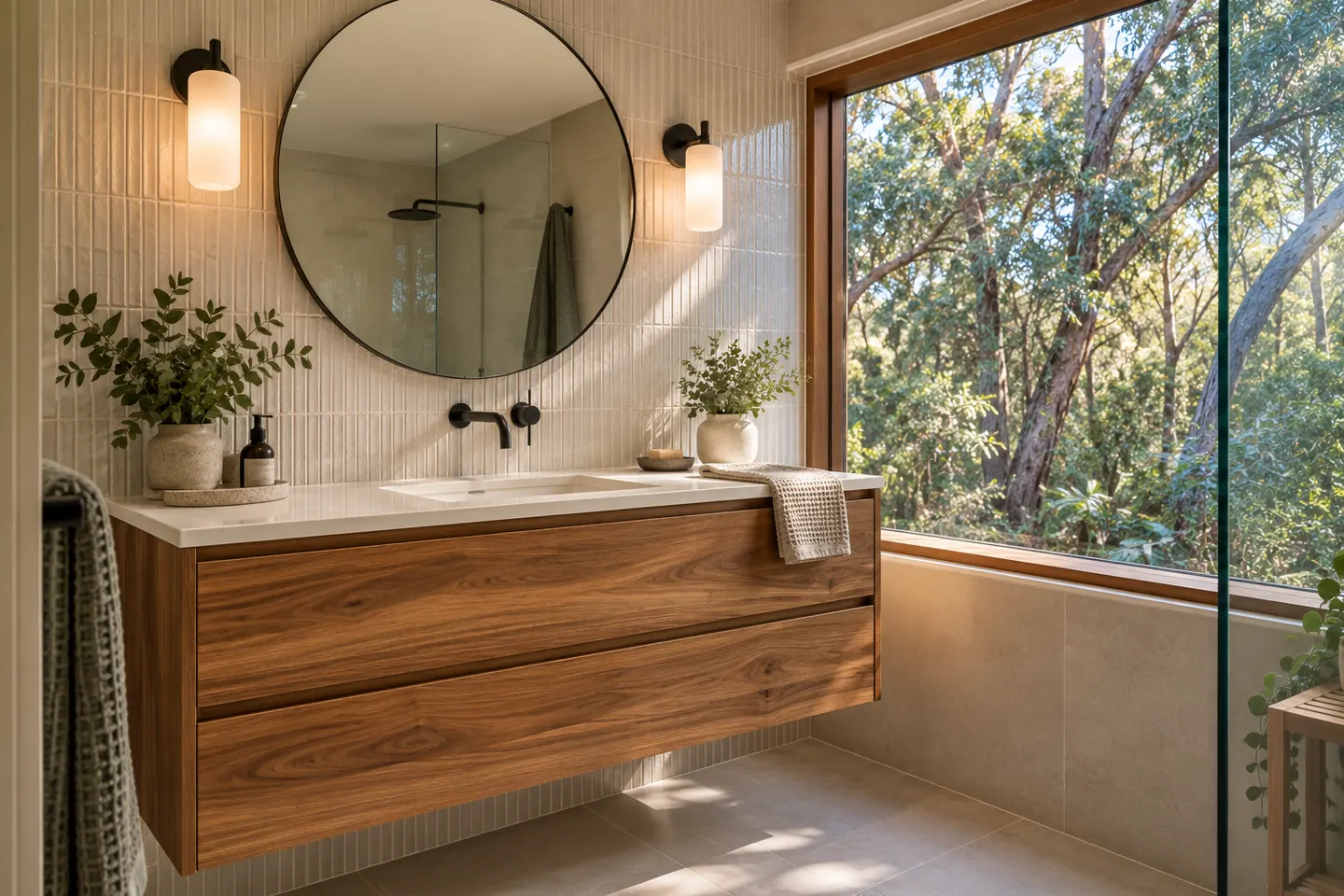
What goes wrong with vanities in older bathrooms
Most vanities that come out of Hornsby Shire bathrooms have failed in the same predictable ways.
- Swollen base panels where water from the floor or basin has soaked into raw particleboard
- Doors that no longer close because the carcass has twisted with moisture
- A dark cupboard with the waste trap in the middle and a single shelf nobody can reach
- Mould inside where a leaking tap connection has dripped unseen for years
- A basin too small for a family bathroom, with no bench space either side
In a humid, shaded bathroom, all of those happen faster.
Choosing a vanity that survives
Carcass material
Look for moisture-resistant board rather than standard particleboard, with every edge sealed, including the cut-outs for the waste and supply pipes. That hidden cut-out is where most swelling starts.
Finish
Two-pack polyurethane, thermo-laminate and quality melamine are all common. Two-pack gives a smooth painted look and can be repaired; thermo-laminate is durable and cost-effective; timber veneer brings warmth but needs to be properly sealed.
Wall-hung or floor-standing
A wall-hung vanity leaves the floor visible underneath, which makes a small room look bigger and makes mopping easier. It needs solid blocking in the wall, which is simple when the wall is open during a renovation.
A floor-standing vanity on legs or a plinth suits some period-style bathrooms and larger family rooms. A plinth must be sealed at the floor so water cannot wick into the base.
Drawers, not doors
Drawers shaped around the waste trap make the whole depth of the vanity usable. A double-drawer unit holds far more than a cupboard of the same width.
Tops and basins
Engineered stone is no longer an option — it has been banned in Australia since 1 July 2024. Good alternatives:
- Porcelain slab: thin, hard-wearing, and available in stone and concrete looks
- Natural stone: marble or granite, which needs sealing and some care
- Solid surface: seamless with an integrated basin, repairable if scratched
- Compact laminate: durable, water-resistant and cost-effective
- Ceramic or cast-marble tops with integrated basins, easy to clean with no joins
Above-counter basins look striking but need more bench depth and clean around the base. Undermount and integrated basins are easier to wipe down, which matters in a room prone to mould.
Storage beyond the vanity
Older bathrooms were short on storage because families kept towels and linen in a hall cupboard. That cupboard is often still there, so bathroom storage can focus on daily items.
- Recessed shaving cabinets set into the stud wall give storage without projecting into the room
- Shower niches keep bottles off the floor and out of sight
- A tall slim cabinet beside the vanity for toiletries and cleaning products
- Towel hooks and heated rails positioned where they are within reach of the shower
- A drawer organiser for the family bathroom so every person has a section
Mirrors and lighting
The mirror and the lighting belong in the same decision as the vanity. A single ceiling light behind you puts your face in shadow. Light at the mirror — a backlit mirror cabinet, wall lights either side, or a strip above — gives even light for shaving and make-up.
In a bathroom with little natural light, a large mirror across the full vanity width reflects the window and makes a significant difference to how bright the room feels.
Tapware for older homes
- Wall-mounted basin mixers keep the benchtop clear and are easier to clean around, but the positions must be set during rough-in
- Traditional cross-handle or lever styles suit homes with period character
- Mid-range tapware from established suppliers usually offers better cartridge life and parts availability than the cheapest options
- Finishes: chrome is durable and easy to maintain; brushed and coloured finishes vary in how well they wear, so check the finish warranty
Sizing for the room
Older bathrooms rarely suit off-the-shelf sizes perfectly. The measure checks:
- Width available between the wall and the shower or door swing
- Depth, particularly in narrow rooms where a shallow 350–400 mm unit may be needed
- Where the wastes and supplies come through, which affects drawer layout
- Window position, because a mirror cabinet cannot always sit centrally
Custom sizing costs more than a standard unit, but in an older room it often gives a better fit than trying to squeeze in a stock width.
Where this fits
Vanity selection is part of every complete bathroom renovation, ensuite and small bathroom. Locking in the vanity, basin and tapware before the start date avoids delays at rough-in. The cost guide shows how fittings affect the total.
Renovation work is carried out in partnership with Coastal Renovation Group, a licensed NSW builder. Licence and insurance details are provided on request.
Call 02 5926 2135 or send the room details through.
Questions people ask before they commit
What vanity material lasts best in a humid bathroom?
Moisture-resistant board with a quality two-pack or thermo-laminate finish, sealed on every edge, performs well. Solid timber can work if it is properly sealed. Standard particleboard with raw edges around the waste cut-out tends to swell over time.
Can I just replace the vanity without renovating the bathroom?
Often, provided the wall behind is sound and the new vanity covers the same tiled area or the tiles can be patched. The catch in older bathrooms is that removing the old vanity may reveal untiled wall, old pipes or damage behind it.
Is engineered stone still available for vanity tops?
No. Engineered stone has been banned in Australia since 1 July 2024. Popular alternatives are porcelain slab, natural stone, solid surface, compact laminate and ceramic or cast basins with integrated tops.